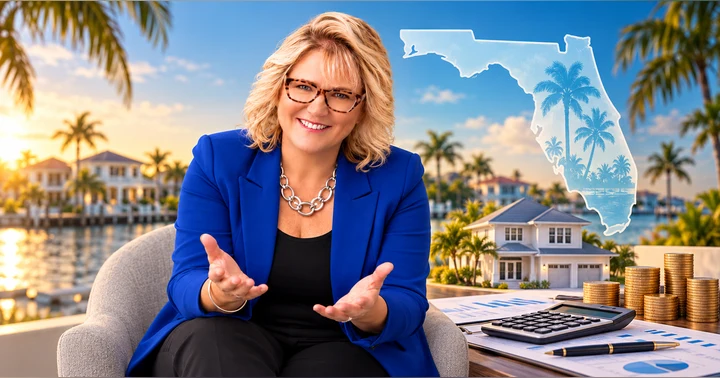
St. Augustine Real Estate Market Reality Check: What Buyers and Sellers Are Getting Wrong Right Now

The St. Augustine and St. Johns County real estate market in 2025 is not the frenzied sellers' market of 2021 or the rate-shock paralysis of 2023. It is something more nuanced, and according to Bailey Martin, that nuance is exactly where buyers and sellers are getting into trouble. Bailey is the founder of STA Sunrise Realty, a boutique brokerage based in St. Augustine, and a licensed Florida real estate broker with nearly a decade of experience and more than $60 million in closed sales. She returned to the Real Estate Excellence Podcast for a candid, unfiltered conversation about what is actually happening in northeast Florida real estate right now.
What she shared is the kind of market intelligence that typically stays in the car between an agent and their client. Here, it is laid out clearly for anyone who is buying, selling, or simply trying to understand what is happening to home values in one of Florida's fastest-growing corridors.
The Sentiment Problem: Why Both Sides of Every Deal Feel Like They Are Losing
One of the most striking observations Bailey made during her conversation was about market psychology. In a balanced or shifting market, where homes take longer to sell and buyers have more choices, a strange dynamic emerges. Neither side feels good about the deal.
"People are nervous right now. There is a lot of uncertainty. People watch the news and the doom and the gloom, and people are scared, especially with prices high and rates high. They feel like they're not getting a good deal, and the seller also feels like they're not getting a good deal either because they have an inflated opinion of what they think their home is worth."
This dual dissatisfaction creates friction at every stage of a transaction. Buyers hesitate at offer time, sometimes canceling at the last moment because they cannot shake the feeling that they are overpaying. Sellers resist price reductions because they remember what their neighbor sold for in 2022. Both sides end up frustrated, and deals fall apart not because of a real problem but because of a perception problem.
The solution, Bailey believes, is honest guidance delivered early and consistently. An agent who tells clients what they want to hear may close more initial contracts, but they collapse more often at the finish line. An agent who tells clients what they need to hear keeps transactions together because everyone is working from accurate information rather than wishful thinking.
The Biggest Mistake Sellers Make: Overpricing Based on Yesterday's Market
Sellers who bought between 2022 and 2025 are facing a particularly difficult reality. Many of them purchased at or near the peak of the market, and some are now trying to sell in a market where buyers have more inventory, more leverage, and less urgency. The numbers are not always what they hoped.
"I'm seeing pretty much everybody who bought at the end of 2022, '23, '24, and '25 who are trying to sell, and they're losing money. They're having to bring cash to the table."
The situation is especially acute in new construction communities where the original builder is still actively selling. When a resale homeowner lists their home in the same neighborhood where a builder is offering brand-new inventory with rate buydowns and full closing cost contributions, the resale product is at an almost impossible competitive disadvantage. Bailey's advice to anyone in that situation is blunt: wait. Get more equity. Let the builder finish. Trying to sell into builder competition before you have the equity cushion to absorb it will cost far more than patience would.
For sellers who are not in that situation, the most common mistake is clinging to a price point based on what homes were selling for in a stronger market rather than what comparable homes are actually selling for today. This leads to extended days on market, reduced buyer activity, and ultimately a lower sale price than a well-priced listing would have generated from the start.
Bailey is direct about this with her clients even when the conversation is uncomfortable. She shared that many sellers reach out, sit down to review the numbers, and say with genuine disbelief: "I can't even believe this. We can't afford to sell." Her job in that moment is not to soften the news but to help them understand their real options, which may include staying, renting, or making strategic improvements before listing.
The Biggest Mistake Buyers Make: Focusing on the Rate Instead of the Life
On the buyer side, the most persistent obstacle is the rate objection. Buyers who need to move or genuinely want to move are talking themselves out of action because they are comparing today's interest rate to the 3% or 4% rate they had, or their friends had, or they heard about on social media. Bailey addresses this head-on, and she does it from personal experience.
When she and her family decided to leave Heritage Landing and move to Anastasia Island, they had a 4% mortgage rate and a very low monthly payment on a home they had owned for eight years. The rational financial case for staying was clear. They moved anyway, and Bailey says it was one of the best decisions she has ever made.
"Are we gonna stay in this home forever because it's cheap, or are we gonna go live our life and be where we want to be? You only get one chance at this, and I wanna be happy on a daily basis. I don't wanna just stay somewhere because it's cheaper."
She also makes a point that many buyers overlook entirely. If a buyer purchased their home when rates were at historic lows, they almost certainly purchased it when home prices were also significantly lower than today. That means they have accumulated substantial equity. That equity can be deployed as a larger down payment on the next home, which reduces the monthly payment and changes the rate-sensitivity calculation dramatically. It can also be used to buy down the interest rate, though Bailey cautions buyers to do the math carefully on that strategy before committing.
"So many people are focused on rates and purchase prices, when really they need to be looking at the monthly payment."
First-Time Buyers: The 20% Down Payment Myth Is Costing People Equity
One of the most persistent misconceptions among first-time buyers in the St. Augustine market is that homeownership requires a 20% down payment. Bailey hears this constantly, and she works hard to replace that myth with the actual landscape of available options.
She shared a recent example that illustrates what is actually possible. A client of hers, a newly credentialed school teacher who had just graduated college, wanted to buy a home but did not have a large down payment saved. Bailey connected her with a local lender who identified her eligibility for Florida's Hometown Heroes program, which provides down payment assistance to educators, healthcare workers, and other qualifying professions.
The result was a townhome purchase in the Bridgewater community, a newer D.R. Horton development, with the seller covering all closing costs and the Hometown Heroes program covering the down payment. The buyer moved in with essentially zero out of pocket beyond her earnest money deposit, which she received back at closing.
"I think a lot of people whenever I start talking to them, they're like, 'We don't know how we're ever going to save 20%.' And they're not wrong, but it's just so hard to save for a down payment whenever rent prices are so high as well."
The key, Bailey emphasizes, is getting the right lender involved early. Different programs have different credit score requirements, income caps, and property eligibility rules. A buyer who assumes they cannot afford to buy without fully exploring their financing options may be renting unnecessarily for years, paying down someone else's mortgage instead of their own, and missing out on the equity accumulation that is one of the primary paths to long-term financial stability.
The Florida Insurance Reality That Changes Every Transaction
No conversation about buying or selling in northeast Florida is complete without addressing insurance, and Bailey does not shy away from it. She has seen it derail deals, surprise buyers after closing, and cost sellers unexpected money during negotiations. Her approach now is to get ahead of it from the very first showing.
"I'm not waiting until we're at the closing table to say, 'Ew, your water heater is 20 years old.' No, when we originally walk the home the very first time I am noting that and pointing that out to you."
The elements that matter most to Florida insurance carriers are the age of the roof, the age and location of the water heater, and the flood zone designation of the property. A roof over ten years old may limit the number of carriers willing to provide coverage, and a roof over fifteen years old may reduce that number to one. A water heater that is aging toward the end of its useful life can trigger similar issues. Bailey identifies these factors immediately and factors them into her negotiation strategy for her buyers, seeking credits or replacements before the deal closes rather than discovering problems after.
She also noted that some carriers will bond a buyer at closing based on a roofing company letter certifying useful remaining life, but then reinspect within ninety days post-closing and reverse that decision. Buyers who have experienced that outcome end up calling their agent in a panic. Bailey has been that agent, and she now structures transactions to minimize the likelihood of that scenario from the outset.
For anyone relocating to St. Augustine or any part of northeast Florida from another state, the insurance landscape here operates differently than what they may be used to. Understanding the rules before making an offer is not optional. It is essential.
Short-Term Rentals and Investment Properties: The Math Is Tighter Than It Looks
St. Augustine's appeal as a tourist destination makes it a natural draw for buyers interested in short-term rental income. Bailey works with investors and second-home buyers across Anastasia Island and the broader St. Augustine market, and her honest assessment of the vacation rental landscape right now is one that prospective investors need to hear.
"After COVID, the market got flooded with Airbnbs. And so there's still so many that it's pushing down Airbnb income. It's usually a lot tighter than people think."
She described working with an investor who had up to a million dollars to deploy and wanted to generate $10,000 per month in rental income from an island property. After extensive research, the best scenario she could model generated approximately $8,000 per month, still $2,000 short of the target, with no guarantee of occupancy consistency. That investor is now exploring multifamily options in Jacksonville, where the numbers pencil out more favorably.
The short-term rental market on Anastasia Island also has a regulatory layer that buyers must understand before purchasing. St. Augustine Beach has its own planning and zoning authority, which governs short-term rental permits independently of the county. Buying a property assuming it can be operated as a vacation rental without first verifying its eligibility under current zoning is a costly mistake that Bailey has seen buyers make.
Strategic Listing Marketing: What Most Agents Skip
For sellers working with Bailey, the marketing process begins long before a listing goes live. She is deliberate about photography, staging, and digital presentation in a way that she says many agents underestimate.
"95% of people who are starting their home search are doing it online. So having an amazing online presence is key. Don't cheapen anything. If the home needs to be staged, let's get it staged. We're in a market where there's a lot of competition and a lot of homes, and we just wanna make sure ours is standing out."
She uses 3D tours, professional floor plans, targeted social media promotion, and works with a vetted photography team she describes as genuinely exceptional. For occupied homes, she often brings in a staging consultant who can direct the seller to declutter, reposition furniture, and remove personal items, a service that typically costs under $200 and generates a return that far exceeds its cost. For vacant homes, she uses virtual staging to help online browsers visualize the space as a home rather than an empty shell.
The goal in every case is to make the home look so compelling online that buyers are motivated to schedule a showing, because a showing that does not happen is a buyer who never had the chance to fall in love with the property.
The Emotional Truth Beneath Every Transaction
Perhaps the most important thing Bailey said in her entire conversation was this: when a seller gets upset over a $300 credit request during negotiations, it is almost never really about the $300.
"It's an emotional transaction, and when I see a seller getting upset about a $300 credit, I'm like, 'What's really going on? Are you having second thoughts about selling your home? You guys have been here, you raised your family here. This is really hard.'"
Real estate is the largest financial transaction most people will make in their lifetime. It is also, frequently, one of the most emotionally charged. Bailey has learned to listen beneath the surface of negotiations for what clients are actually experiencing. She gives them patience. She gives them grace. She creates space for the emotional reality to surface, because when it does, the path to resolution becomes much clearer for everyone involved.
That combination of honest market knowledge, proactive problem-solving, and genuine human care is what Bailey Martin has built her reputation on over nearly a decade in St. Augustine. The market will keep shifting. The communities will keep growing. The insurance rules will keep evolving. Through all of it, the most valuable thing a buyer or seller can have is an agent who will tell them the truth, advocate for their actual interests, and stay in their corner from the first conversation through closing and long after.
If you are buying, selling, or simply trying to understand the St. Augustine or St. Johns County market, consider what it might look like to have that kind of advocate on your side.

Host of Real Estate Excellence | Mortgage Loan Officer NMLS #23368
Tracy Hayes is the host of Real Estate Excellence, a podcast dedicated to bringing you real conversations with top-performing real estate professionals across Florida and beyond.
A mortgage loan officer with nearly two decades of industry experience (NMLS #23368), Tracy brings a unique perspective to every interview — combining deep lending expertise with a genuine passion for the people and stories that shape the real estate industry.
Based in Northeast Florida, Tracy has spent years building relationships with the agents, brokers, team leaders, lenders, and coaches who are setting the standard in today's market. Real Estate Excellence is his platform for sharing their unfiltered insights with agents and real estate professionals who want to grow, lead, and succeed.
Serving Baby Boomers and Downsizers: What Jacksonville Real Estate Gets Wrong About This Client