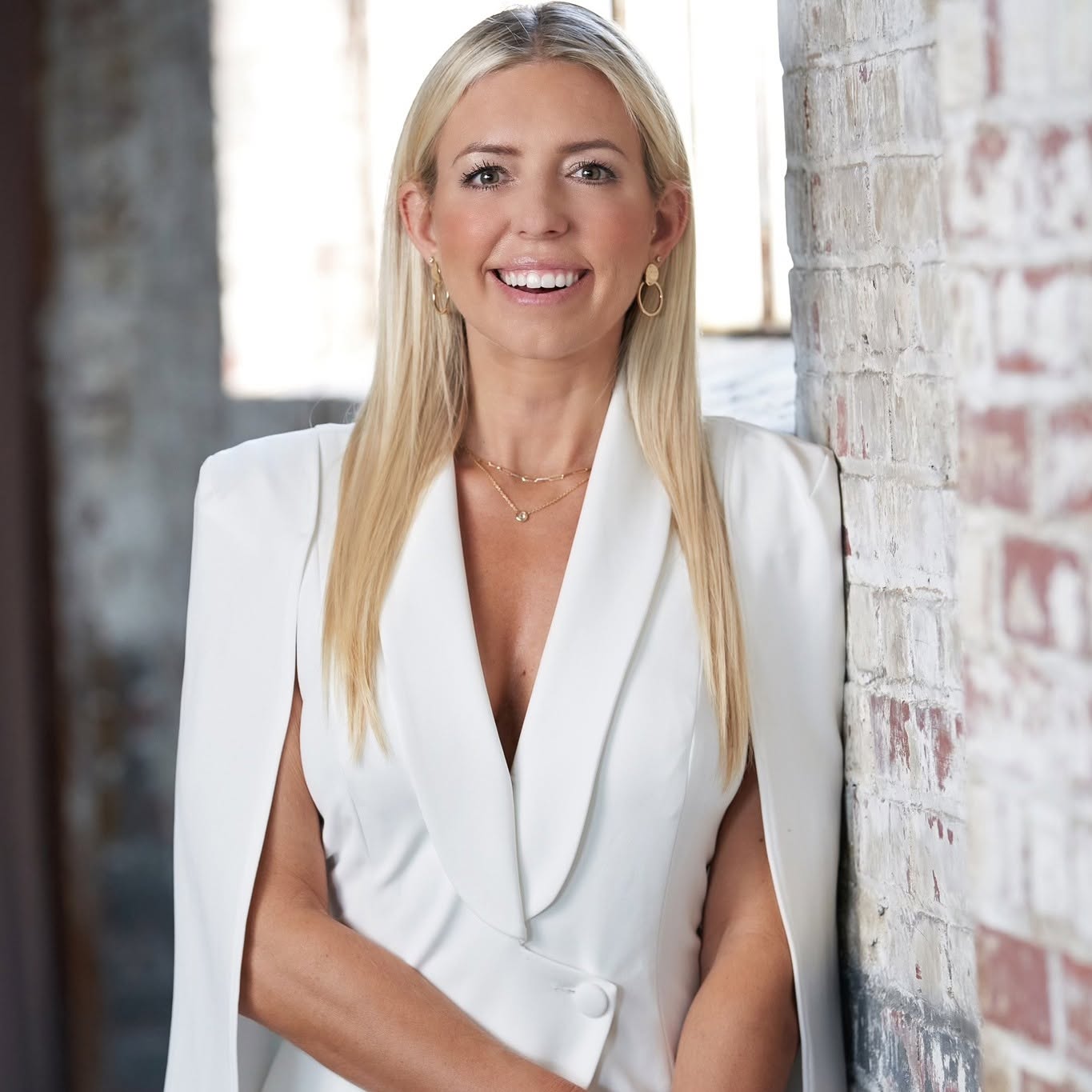
Sarah Rocco Started at 28 With Three Kids and No Backup Plan: How She Built The Rocco Group in Six Years
In March 2026, the Northeast Florida Association of REALTORS® counted 6,901 active listings across the region, 3,350 of them in Duval County at 3.5 months of supply, according to NEFAR figures reported by News4JAX.
In the spring of 2022 the same region had almost nothing to sell. Sarah Rocco put the number on it herself: the market had once carried eight to ten thousand listings, and by the time she was talking it was down to about 1,800. She had started on January 1, 2016, helped 27 families in her first twelve months, and six years later was running a team that earned Keller Williams quadruple platinum status in 2021 and sat, by the episode's own accounting, in the top 0.1 percent of Jacksonville agents.
What makes the conversation worth revisiting is not the volume. It is that almost everything she describes is a system somebody could copy on a Tuesday. An alphabetized friends list. A 24-transaction buyer apprenticeship before you go near a listing. An agreement she called "the promise."
Sarah died in December 2023, nineteen months after this recording. That is covered plainly further down. It also makes this hour one of the more complete records of how she actually ran the business.
Twenty-Eight, Divorced, Three Kids, and No Backup Plan
She was born in Billings, Montana and moved to Florida young when her father transferred steel companies. She skipped college, married early, had three children and homeschooled them for years. At 28, the whole structure came apart.
"It was surprising, and I had to really invent myself, because my only identity was a mom at that point," she said. "And so when I think of these other single mothers going through identity challenges, I can completely relate to that."
An aunt in Montana, an entrepreneur who had never gone to college, planted the idea. A sister-in-law in Atlanta with a new license confirmed it. Sarah got licensed and started on the first day of 2016.
"There was no backup plan. It was either I succeed at this, or else there's nothing else," she said. "You got three kids, hungry kids, and you have to make it work."
She did not look for an edge. She looked for instructions and followed them literally.
"If they said to door knock, my golly, I would door knock five times a week," she said. "And I didn't know that actually, most people don't do that."
The $2,500 Conference and the Ten Minutes She Asked For
Early that first year she was invited to Family Reunion, Keller Williams' national convention. She could not really afford it.
"I wouldn't be where I am today had I not been invited to Family Reunion, which is a large conference, right after I started," she said. "I went to that conference. It cost me money. It was painful. The growth I experienced in that one conference changed my life."
What she did with the speakers is the repeatable part.
"One guy was on the stage, and afterwards I reached out to him on Facebook, and I was like, can I get 10 minutes of your time?" she said. "And that is one thing I always do. The speaker, I address immediately."
Ten minutes turned into a flight. "They flew me out to Maryland to meet the team," she said.
It also changed how she saw the ceiling on her own business. "I was very small minded prior to that event," she said. "It was Sarah sells Jax, which is very singular, very focused, inward. But I realized that to attract talent to that, I'd hit a ceiling pretty quickly."
She Changed Her Name Eight Months In
About eight months in she made a branding decision most people would never consider. She was operating under her married name.
"I was Sarah Schneider at the time. I was like, well, there's no way," she said. "So I went back to my maiden name. And Rocco's such a strong name."
Her first year ran from a $33,000 purchase up to the three and four hundreds. The rest of the early marketing was equally unremarkable, and she wanted new agents to hear that.
"It wasn't fancy. Now we're so focused on it being perfect and on Canva for five hours before door knocking," she said. "It was not fancy. I was literally plugging into whatever CRM was provided by Keller and printing off a very generic flyer."
She was an early mover on social media and treated it as documentation rather than production. "I was an early adapter of social media, so I jumped in right away," she said. "I posted when I was door knocking, I posted when I was doing open houses."
She had moved to Jacksonville after her divorce, to a city where she knew nobody. "My only friends were the people that would talk to me at Starbucks," she said.
She was blunt about the timeline. "It takes about six months to see any type of results from social media," she said. "You'll get likes and clicks and shares and all of that. But as far as actually getting income earning ROI from it, it takes about six months."
The Alphabetized Friends List and the Fur Babies
Here is the unglamorous mechanic under it. Sarah did not have a content strategy. She had a filing system.
"I was a big proponent of Facebook, so I have my friends list alphabetized, and then every quarter I reach out to those letters of the alphabet," she said.
The second half makes it work. She put what people volunteered publicly into the CRM, so the next conversation had a hook that was not about real estate.
"A lot of people share their personal life on social media all the time, and then I'll plug it into the CRM so I have that info," she said. "And then when I call them, it's more so like, oh my gosh, I saw Jimmy won his tournament. And then I'm writing that their son's name is Jimmy, and he turns six."
Then the line that reframes the exercise: "People want you to know more about their children and their fur babies than their own life."
She kept the channels separate on purpose. "My Instagram page is all personal, and we have the business page, because I have just chosen that I want people to get to know me," she said.
Underneath, she was working a tension she thought the industry had not named. "In an industry where you could be replaced with technology and AI and so many other disruptors, the relationship is going to be crucial," she said. "But now what we're seeing is people are choosing convenience over the relationship. So how do you become the convenient person?"
Her answer was operational, not sentimental. "It's no longer just standard real estate. You have to have a menu of services you provide," she said. That menu included a cash offer program and a renovation concierge: "If they don't want to put in the upfront money to renovate their home to get a higher ROI, we fund all of that up front, and they pay out of the proceeds." Paint, flooring, cabinets, paid at closing.
Ten Support Roles, Seven Agents, and the One Quarterback Rule
The structure she described in May 2022 was heavy on operations by design: three virtual assistants in the Philippines, two in-house transaction coordinators, a listing manager, a marketing director, a videographer, two inside sales associates, seven agents.
"Our goal at the Rocco Group is to take off the 80% off the agents' plates so they can do their 20%," she said. "Show up for customers, shake hands, kiss babies."
The VAs functioned as an agent concierge: phones Friday through the weekend, showings, drafted purchase contracts, offer templates. On a listing with twenty offers they assembled the seller's comparison spreadsheet. But there was a hard boundary. "They don't send it out. We don't allow that," she said. They also never touched the past-client database: "They could cold call, but not my database."
The hiring philosophy was the sharpest thing she said all hour. "I see too many team owners that hire more of them," she said. "They hire another quarterback. They hire multiple quarterbacks on the same team. You don't need that."
To avoid it she ran DISC plus a KPA behavioral assessment, then went further. "We go into life story motivation, because I want to know, if someone comes into my organization, what their entire life looked like, where they struggled, where they excelled," she said.
The agent path was equally specific. "Our model is the first 24 families helped are buyers. Once you test out of that, then you go through a listing boot camp that then allows you to be a dual agent," she said. Lead flow ran 75 percent team-generated, 25 percent agent-generated, each agent choosing three lead generation levers, and a full-time showing assistant unlocked at roughly 60 transactions a year. She preferred to recruit people about six months in, once they had started on their own and hit the wall.
The Promise: Five Stars for a Referral or a Review
Asked to name one process she ran every day, she named a contract with the client that most teams only imply.
"We call it the promise," she said. "Before we agree to work with them, we give them a promise that we'll give them a five star experience, and in return they have to give us a referral or a review. And if we get to the closing table and we don't have one of those, then we're going to sit down and be like, okay, what could we have done differently to make it a five star?"
The mechanism is the debrief, not the ask. Setting the expectation at intake turns a missing review into a diagnostic rather than an awkward favor.
Her own standard had the same shape. "My work love language is responsiveness, like acts of service," she said. "So being oddly responsive." She checked the dependency that creates by handing the question back: "Hey, if I didn't answer that question, where would you go? And then next time they don't come, because they know where they would go."
The Part She Said She Was Bad At
She did not present the operation as finished. Asked how she helped agents work their spheres of influence, she gave the least polished answer of the hour.
"Honestly, we're not that great at it," she said. "It's our focus in 2022 to teach them how to have those conversations with their sphere of influence, teach them to dig into the uncomfortability of making it a work conversation."
She had also just lost two of her most senior staff. "We recently reshuffled the deck, and our Director of Operations and executive assistant saw other opportunities, so we're actually hiring right now," she said. "I have eight interviews this week. We had like 100 plus applicants."
Early on she quit the cohort she went through pre-licensing education with, because the negativity was contagious. Six years on the scoreboard was stark. "I look back at my core Ignite group, and there's maybe two people out of 20-some that are in the industry today," she said.
She carried three standing calls a week, two coaches and a mentor, and had kept a coach continuously since October 2016 except for a year off in 2020. The mentor, Peter Darby, was a past client from California who mentioned he enjoyed mentoring people while she was selling him a house.
"I said, should the transaction go well, would I be able to earn the opportunity to have you as my mentor?" she said. "And so we talk every Monday at 2pm. We have for years." When she asked how to pay him, "he said, pay it forward."
Her ambition had also changed shape. "My vision has changed a little bit, because I'm a big proponent of work life balance and having a really big personal life," she said. "Number one isn't so much the goal, because I realized that was a little bit ego driven."
What Happened Next
The episode aired May 5, 2022, as episode 65 of the Real Estate Excellence Podcast, and it remains Sarah's only appearance on the show.
On December 11, 2023, Sarah was driving east on U.S. Highway 90 in Baker County when a westbound van struck her head-on. She was hospitalized in critical condition and died two days later, on December 13, 2023, at the age of 39. Action News Jax reported the crash and interviewed her brother, Matt Rocco, who described her this way: "She had just a real, genuine interest in people's lives." He added, "She was such a person of action. Every single thing that she did, she was very intentional."
The team continued. In an October 2024 Jacksonville Real Producers feature, Rocco Group agent Taylor Diaz described her goal to "continue to develop the team with my managing partner, Rinnell Cohen, and continue to build upon Sarah's legacy," and noted that more than 700 people attended Sarah's celebration of life in the spring of 2024.
Two things she described have shifted since. The inventory picture has reversed, with NEFAR reporting 6,901 active listings across Northeast Florida in March 2026 against the roughly 1,800 she cited in 2022. And the change to buyer representation and commission disclosure that followed the National Association of REALTORS® settlement arrived after this recording, so nothing in the conversation addresses it. What holds up unchanged is the operating architecture: assessment-driven hiring, the buyer-first agent ladder, the support-to-agent ratio, and the promise.
Pick the smallest piece. Alphabetize your database and work one letter block a quarter. Write down the names of clients' kids and pets when you see them posted, because you will otherwise forget. Set the review-or-referral expectation at the front of the engagement instead of begging for it at the end. Before you hire, ask whether you are adding a quarterback to a roster that already has one. And if you go to a conference, ask the person who spoke for ten minutes before you leave the building.
The Rocco Group built its business across Duval County, from the Southside and Baymeadows out through Argyle and Oakleaf, with agents working into St. Johns County and toward the beaches. None of it required a particular market or price point. It required a filing system, a boundary around who does what, and the patience she told new agents to budget for: at least two years of work before the result shows up.
"Number one isn't so much the goal, because I realized that was a little bit ego driven, and I really had to reestablish my why behind why I wanted to create this big life," she said.
Featuring Sarah Rocco · The Rocco Group, Keller Williams Realty Atlantic Partners Southside · Real Estate Excellence × ReadTomato

Host of Real Estate Excellence | Mortgage Loan Officer NMLS #23368
Tracy Hayes is the host of Real Estate Excellence, a podcast dedicated to bringing you real conversations with top-performing real estate professionals across Florida and beyond.
A mortgage loan officer with nearly two decades of industry experience (NMLS #23368), Tracy brings a unique perspective to every interview — combining deep lending expertise with a genuine passion for the people and stories that shape the real estate industry.
Based in Northeast Florida, Tracy has spent years building relationships with the agents, brokers, team leaders, lenders, and coaches who are setting the standard in today's market. Real Estate Excellence is his platform for sharing their unfiltered insights with agents and real estate professionals who want to grow, lead, and succeed.
Why Jacksonville's Best Agents Think About Lifestyle First and Listings Second