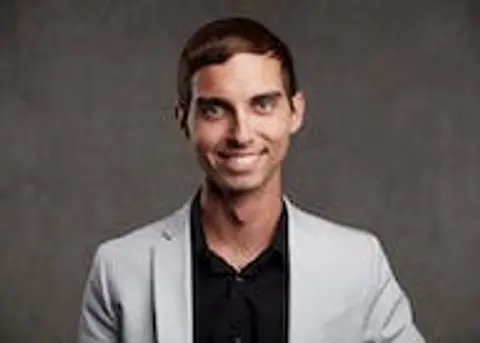
He Posted an AI Version of Himself and Only His Mother Noticed: Matthew Manyak on Building a Video Presence Without Turning On a Camera

In September 2023, Matthew Manyak posted a video of himself to social media. He spoke to camera in his usual black T-shirt, in his usual cadence, saying the things he usually says. At the end of the video, he revealed that none of it was real. The face was an AI model trained on his likeness. The voice was a clone. The script had been generated by a text model trained on his own speaking and writing patterns.
Out of everyone who watched it, exactly one person had called it in advance.
“The only person that called it out from jump was my mom,” he said.
Manyak is a filmmaker and the founder of Double-M Digital in Jacksonville. He is also the co-founder, with Tony Aponte, of Noble Vision AI, a St. Augustine company built to help small businesses adopt AI. He came on the Real Estate Excellence Podcast to explain, in plain terms, what an agent can actually do with this technology and what it costs them in time.
Three years on, the underlying pitch has not aged. If anything, the market has moved toward it. NAR’s 2025 REALTORS® Technology Survey found that 46 percent of REALTORS® now use AI-generated content in their business — and that 32 percent of members had still not used AI at all. That second number is the opportunity.
First, Clear Up What “AI” Even Means
Manyak opened by refusing to let the conversation start in the wrong place.
“There’s this misconception that they’re one and the same,” he said of AI and ChatGPT. “ChatGPT is an AI tool, but it’s not AI as a whole. There’s so much more to it. It’s like saying, do you use AI, do you use the internet — is Google the internet? No. There’s so much more.”
That distinction matters practically, because the avatar workflow he described is not one tool. It is three separate models doing three separate jobs.
The first is a text model trained on how a person actually writes and speaks, so the scripts it produces sound like them rather than like generic marketing copy. The second is a voice clone, built from an audio sample, that will read any script in that person’s voice. The third is a video model trained on their face, likeness, and clothing.
“When you pair all three of them together, you can create a video asset for social media, video sales letters, sales funnels — pretty much anything that’s a talking head, talking-to-camera style video,” he said.
The Actual Workflow: One Hour in Front of a Camera
The part that gets an agent’s attention is the ratio.
Manyak films the subject for roughly an hour against a portable green screen, shot from the waist up. The framing is deliberate: it leaves room to crop and zoom later, so the same avatar can appear in different places and at different distances rather than being locked into a single angle forever.
“You’re stuck in one angle, you’re stuck in one room, you’re stuck in one frame,” he said of the alternative. “When I went in and produced the content for my own avatar, I integrated a green screen, I shot it from the waist up, so now I can do one reel on Jax Beach and then the next reel, same AI avatar model, can be in Las Vegas.”
One caveat he was careful to flag: at the time, each outfit required its own trained model. “It’s not like you can press a button and just change your clothes. If you want three different models, four different models — black T-shirt, gray polo, white blazer — you train up the models on the different ones.” Training several looks in a single session is what buys the ability to make content look like it was shot on different days.
The turnaround in late 2023 was about a month from filming to a finished avatar. Manyak said even then he expected that window to shorten as the underlying technology improved, and it has.
After that, the math changes entirely.
“I can now create 30 reels in the span of probably three hours without having to turn on a camera,” he said.
The Use Case Most Agents Miss
Tracy Hayes pushed him on where this actually earns its keep for a real estate agent, and the answer was not vanity content. It was the recurring, informational, low-glamour video that agents keep meaning to make and never do.
Market updates. Loan limit changes. Neighborhood explainers. Listing voiceovers where the avatar introduces the property, cuts to the walkthrough footage, and comes back at the end with the call to action.
“Market updates, we can automate that,” Manyak said. “Same thing that we just talked about with home tours, we could automate that.”
The neighborhood play is the one Hayes kept returning to. An agent who is nervous on camera can script a video about a specific master-planned community, hand it over, and have the avatar deliver it with photographs of that community behind them. Then do the next community. Then the next. Videos that would never have been made, because the agent could not face a camera on a rainy Tuesday, become a library.
“You want to do a five-minute video talking about Beachwalk, but you’re in Yulee,” Manyak said. “You don’t want to travel down there, shoot the video. Plop the script in, into the voice, into the avatar. We can knock that out.”
There is a second-order benefit that Hayes drew out and that most agents overlook. A prospect who finds you through a video about one community will frequently buy in a different one. The video is not a listing tool. It is a contact tool.
The Conversation That Aged Into a Commission Argument
Late in the episode, the two of them landed on something that reads differently now than it did when it was recorded.
They were talking about the industry’s commission litigation, which was still unresolved at the time, and about what agents were going to have to prove.
“Do you have videos right now talking about what’s the value of a real estate agent? What are things that you do on a daily basis?” Hayes asked. He wanted agents to build a library explaining the work clients never see. “Here’s this house I had to go pick the weeds out of, or we had to scrub down the countertops before the open house. These are things that agents do that we don’t see.”
That was late 2023. Since then the practice changes took effect, written buyer agreements became the norm, and every agent in Northeast Florida now has to articulate their value before a buyer will sign anything. The videos Manyak was describing as a nice-to-have became the answer to a question clients now ask out loud.
What He Told Agents Not to Do
For someone selling AI services, Manyak spent a surprising amount of the episode drawing lines around them.
He was explicit that avatars do not replace on-location or interview content. “If you’re doing content where you’re out there interviewing people — say you’re selling new construction, talking to the builders — it’s not a replacement for that.” A feature on a local restaurant, he said, should be shot on location.
He was equally direct about generic prompting. An agent who types “write me a script for a listing video” into a chatbot will get a generic script back. “The average person that uses ChatGPT is going to put in a basic prompt that’s going to give them a more basic script that may not speak directly to the target audience demographic that they’re trying to reach.” The framework he and Aponte built at Noble Vision AI starts with a written questionnaire precisely because it forces the client to get specific about who they are talking to.
And when the conversation turned to buying followers and paid verification, he took the position most vendors would not.
“Why would you want fake followers? It’s literally just inflating numbers for optics’ sake,” he said. “If you have 100 followers but 99 percent of those followers buy something from you, awesome. If you have 100,000 followers but 0.1 percent buy something from you, you’ve got a flaw in the system somewhere.”
The Line Worth Keeping
The most quotable thing in the episode was not about technology at all. It was about timing, and it applies to any agent sitting in a slow stretch wondering whether the marketing work is worth it.
“When the market is quiet, those who normally talk the softest sound the loudest,” Manyak said.
The argument for doing this work in a slow market is that the alternative is a predictable cycle: the market picks up, the agent gets busy, the content stops, the market slows again — and by then the people who might have called have already found someone else who was still talking.
A Note for 2026
Three things have changed since this episode aired, and they are worth naming before anyone acts on it.
The training timelines described here have compressed substantially. The one-hour-of-filming ratio still holds; the month-long wait largely does not.
Disclosure now matters. Platforms have added labeling requirements for realistic synthetic media, and any agent using an avatar should be labeling it and should confirm current platform rules along with any state or brokerage guidance before publishing.
And the competitive picture has shifted. When this was recorded, an AI avatar was a novelty. NAR’s 2025 technology survey found social media is now the single largest source of quality leads for REALTORS®, cited by 39 percent — ahead of CRM at 23 percent and the local MLS at 17 percent. The question is no longer whether to produce video. It is whether the friction of producing it is what has been stopping you.
For agents across Jacksonville, Ponte Vedra, Nocatee, St. Augustine, Nassau County, and the broader Northeast Florida market, an hour in front of a camera is a low price for removing that friction permanently.
Featuring Matthew Manyak · Noble Vision AI and Double-M Digital · Real Estate Excellence × ReadTomato

Host of Real Estate Excellence | Mortgage Loan Officer NMLS #23368
Tracy Hayes is the host of Real Estate Excellence, a podcast dedicated to bringing you real conversations with top-performing real estate professionals across Florida and beyond.
A mortgage loan officer with nearly two decades of industry experience (NMLS #23368), Tracy brings a unique perspective to every interview — combining deep lending expertise with a genuine passion for the people and stories that shape the real estate industry.
Based in Northeast Florida, Tracy has spent years building relationships with the agents, brokers, team leaders, lenders, and coaches who are setting the standard in today's market. Real Estate Excellence is his platform for sharing their unfiltered insights with agents and real estate professionals who want to grow, lead, and succeed.

Why Jacksonville's Best Agents Think About Lifestyle First and Listings Second