Agrarian Revival and the 11 at Congaree and Penn: A New Vision for Luxury Land Living Near Jacksonville
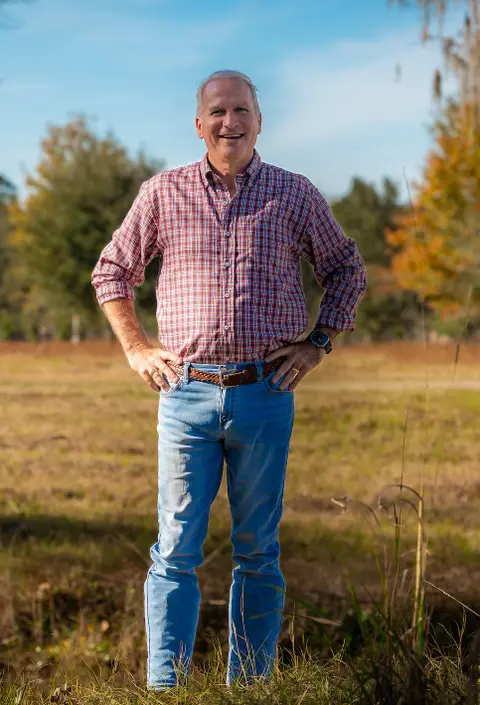
There is a 100-year-old oak tree on a 330-acre farm northwest of Jacksonville, Florida, where John Hillman envisions dinner parties lit up with string lights, neighbors arriving by golf cart from their 10-acre claims, and a chef from the on-site restaurant setting up in the field. It is the kind of scene that sounds like it was invented for a magazine spread. What makes it unusual is that it is actually being built.
John Hillman, an agent with Cabana Lane in Fernandina Beach, is one of the driving forces behind a project called the 11 at Congaree and Penn, a collection of eleven 10-acre parcels carved out of a working farm and restaurant property just off Old Kings Highway in north Jacksonville. The concept has a name: agrarian revival.
"Agrarian revival is built on this notion that your land, your food sources, and how you live should all be one integrated system."
It is not a subdivision. It is not a farm cooperative. It is something that does not have a clean category yet, which is part of what makes it worth paying attention to.
The Farm Behind the Concept
Congaree and Penn is already a destination. The property is home to a working farm and restaurant that has operated for years, drawing Jacksonville families for seasonal events like a pumpkin patch that moves five to ten thousand pumpkins annually. The kitchen mills its own rice, produces jellies and cider from a rare fruit called the meha grape (harvested from hawthorn trees each May), and has a bar program that features its own cider at establishments across Jacksonville.
John came to know Scott and Lindsay, the stewards of Congaree and Penn, as a customer. He was buying trees from their farm. Over three to four years, a deeper conversation evolved about what the land could become beyond what it already was.
"Scott coined this phrase: conservation through development," John explained. "Most of the time with development, you're trying to maximize. In this case, we're able to get a return using 30% of the land, so we're actually able to conserve 70%."
The 330 acres break into distinct zones. The first 100 acres anchor the restaurant, orchards, and hospitality operations. A middle district of roughly 150 acres holds open hay fields and pasture. A wooded section houses 13 Amish-built cabins available for overnight stays. The final 100 acres at the far end is where the eleven farm claims are being carved out.
What Owning a Claim Actually Means
Each of the eleven parcels is referred to as a claim rather than a lot, a deliberate choice that signals a different kind of ownership responsibility.
"You buy a claim from Scott and Lindsay. Now you have a responsibility to shepherd that land, and you have to actually name it."
John and his wife named their own claim Arden, after the magical forest in a Shakespeare play, because their parcel transitions from open pasture to deep woods to the edge of the Cary State Forest. The name has to be original. It cannot simply be a family surname. The naming ritual is designed to create a sense of identity and custodianship from the moment of purchase.
Buyers are asked to build something on their claim within two years. The threshold is low by design. A potting shed qualifies. But the prompt exists to keep the community alive and developing rather than sitting dormant.
The architectural language for the community has been established in partnership with Pierce Scott Architects out of Bluffton, South Carolina, the firm behind the aesthetic framework at Palmetto Bluff. The guiding idea is what John calls honest architecture: buildings that are rooted in functional history rather than decorative imitation.
"Old farm buildings were functional," he said. "If it was a hay loft, it was extra tall so the hay could dry. We really are into this notion of honest architecture. It's not somebody adding third gables on things."
Who the 11 at Congaree and Penn Is Built For
John describes the buyer profile in generous terms. The property sits approximately six to eight miles from Jacksonville International Airport as the crow flies, which puts downtown Jacksonville within about 25 minutes. That proximity makes it viable for working professionals who want a retreat without sacrificing access to the city.
He sees multiple buyer types fitting naturally into the project: busy professionals in law or medicine who want a weekend property with room to breathe; families interested in multigenerational living, since the agricultural zoning fully supports auxiliary dwelling units and even full compound development with a main house and additional cottages; equestrian enthusiasts, because co-owner Lindsey Meyer is an accomplished rider who competes in dressage and hunter jumper, and the state park land adjoining the property provides thousands of acres of trail access; and possibly professional athletes who grew up in rural environments and want to stay connected to that way of life while remaining close to the Jaguars facility.
John is also pursuing partnerships with Jacksonville builders and designers who understand the aesthetic. Riverside Custom Homes, with Matt Birdwell leading the effort, is constructing the first home on the property, expected to be completed in fall of next year. DF Luxury Homes with Marcus Mead is the second builder involved. Architecture and interior design contributors include Troy Sperlin, Julie Sanford from Star Sanford, and practitioners from Atlanta, Charleston, and Beaufort who understand low country vernacular in a farm context.
Land values range from $650,000 to $1 million per claim. The first completed home is expected to come in between three and four million dollars.
The Shared Benefits: Community Within the Farm
One of the more unusual aspects of the 11 at Congaree and Penn is how the restaurant and hospitality operation becomes a shared amenity for property owners without being a formal club structure.
Residents will have cashless access at the restaurant, with a built-in account tied to their property. A chef's dinner at a buyer's home is not a fantasy; it is a service the culinary team will provide. Scott's fleet of mobile food trucks can set up in the hay fields for neighborhood gatherings. The pumpkin patch, the cidery, the bread and tomato clubs that allow members to receive regular farm harvests: all of these become part of the rhythm of life for claim owners.
"You wake up overlooking nothing but nature, and you can just get on a golf cart," John said, describing a recent overnight stay in one of the farm's cabins. "When you're out there, you don't need your car for anything. You go by bike, horse, or golf cart."
Conservation Through Development and the Tax Advantage
Because the parcels carry agricultural zoning, property taxes are a fraction of what comparable acreage would carry under residential zoning. In a moment when carrying costs on luxury real estate have become a significant concern, that structural advantage is not a minor footnote.
The conservation math matters too. By concentrating development on a defined portion of the land and committing the rest to agricultural and natural preservation, the project protects the character of the farm rather than consuming it. It is a model John sees as a template for how large landowners can monetize their holdings without surrendering what makes them worth having.
Quiet Luxury as a Design Philosophy
The 11 at Congaree and Penn fits into a broader idea John has been developing, one he connects to his work at Crane Island and to the evolving appetites of affluent buyers across generations.
"I still think, even agrarian revival is about this idea of quiet luxury. Your luxury doesn't have to come with every accoutrement imaginable. In fact, we almost see it as like really thoughtful editing in your life, to just get to where you really need to be, not what you must have, or what your friends have."
As of now, one claim has been purchased, one is under construction, and John and his wife have purchased one for themselves. Eight remain available. John plans to host what he calls Dusty Boots Tours in the coming weeks, inviting Jacksonville-area real estate professionals to walk the land and experience what the project actually feels like underfoot before trying to explain it to potential buyers.
The Takeaway
The 11 at Congaree and Penn asks a question that the luxury real estate market does not hear very often: what if less land cultivated more intentionally, surrounded by more nature and more community, turned out to be the most desirable thing money could buy?
For buyers who have spent years acquiring more, the more interesting question might be what they actually want their days to feel like. That answer, for a certain kind of buyer, might look a lot like a 10-acre claim with a name they chose themselves, a dinner under an oak tree, and rice grits from a farm down the road.
Featuring John Hillman · Cabana Lane · Real Estate Excellence × ReadTomato

Host of Real Estate Excellence | Mortgage Loan Officer NMLS #23368
Tracy Hayes is the host of Real Estate Excellence, a podcast dedicated to bringing you real conversations with top-performing real estate professionals across Florida and beyond.
A mortgage loan officer with nearly two decades of industry experience (NMLS #23368), Tracy brings a unique perspective to every interview — combining deep lending expertise with a genuine passion for the people and stories that shape the real estate industry.
Based in Northeast Florida, Tracy has spent years building relationships with the agents, brokers, team leaders, lenders, and coaches who are setting the standard in today's market. Real Estate Excellence is his platform for sharing their unfiltered insights with agents and real estate professionals who want to grow, lead, and succeed.

Serving Baby Boomers and Downsizers: What Jacksonville Real Estate Gets Wrong About This Client